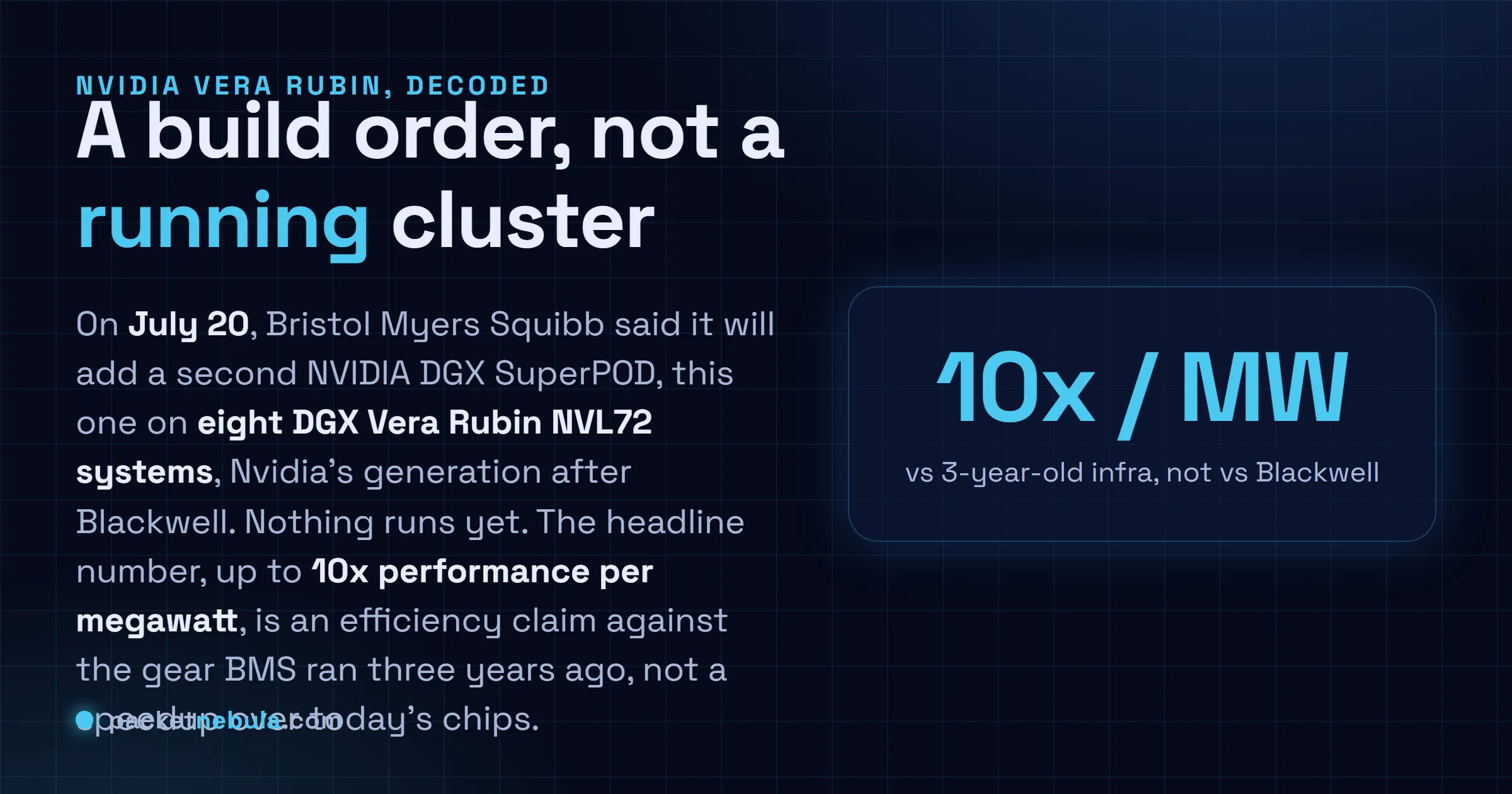
So Bristol Myers Squibb put out a press release on July 20, and the headline calls it the most powerful AI factory in life sciences. Read past the headline and here's what actually happened: BMS committed to a second NVIDIA DGX SuperPOD, this one built on eight DGX Vera Rubin NVL72 systems, Nvidia's generation after Blackwell. Nothing runs yet. Rubin is second-half-of-2026 silicon that's only now reaching its first named customers, so a deployment here is a purchase order and a build plan, not a cluster you can log into. The one number everyone will repeat, up to 10x the performance per megawatt, is real. It's also an efficiency claim measured against the gear BMS ran three years ago, not a speedup over today's chips. We went digging into what Vera Rubin actually is.
The short answer
Bristol Myers Squibb says it’ll add a second NVIDIA DGX SuperPOD, built on eight DGX Vera Rubin NVL72 systems, Nvidia’s generation after Blackwell. It’s a build commitment, not a live cluster: Rubin is second-half-2026 silicon just reaching its first customers. The one number to know, up to 10x performance per megawatt, is an efficiency claim against three-year-old gear. Here’s how to read it.
What BMS actually announced
A pharma company bought a lot of GPUs. That’s the honest one-line version.
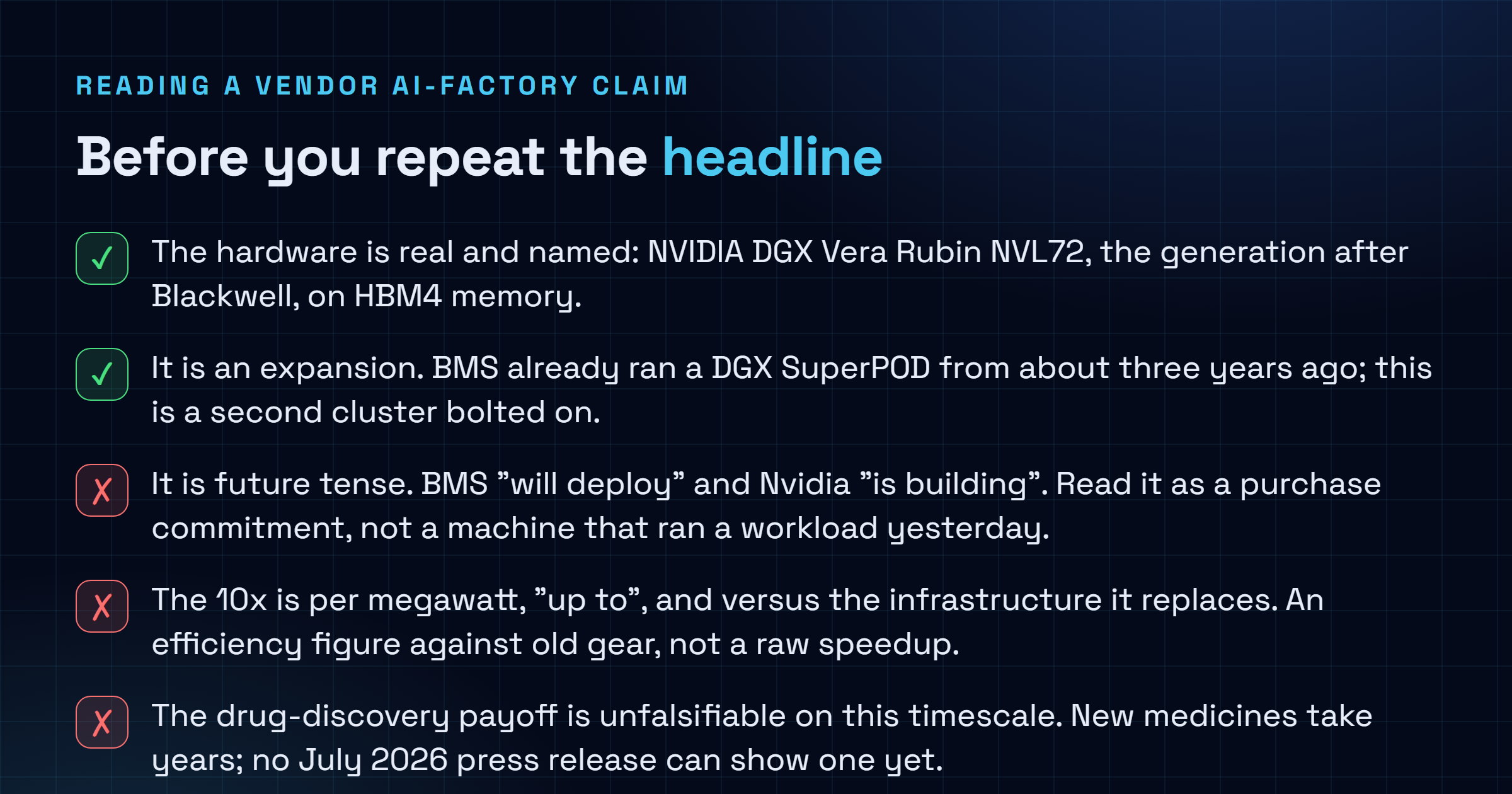
On July 20, Bristol Myers Squibb said it will expand its compute and add a second NVIDIA DGX SuperPOD, this one built on eight DGX Vera Rubin NVL72 systems. Nvidia called the combined estate “the most powerful and energy-efficient AI cluster in life sciences.” Worth noticing the tense. BMS “will deploy”, Nvidia “is building”. Present tense would mean a running machine. This isn’t that.
It’s an expansion, too. BMS first stood up a DGX SuperPOD about three years back, so the new Vera Rubin cluster bolts onto an existing setup rather than replacing it wholesale. What they say they’ll run on it: proprietary foundation models trained on BMS data, plus agentic workflows for things like target identification and validation, riding on Nvidia’s BioNeMo Agent Toolkit. Robert Plenge, BMS’s chief research officer, framed the pitch as learning from every experiment under uncertainty. Fine. That’s a research goal, not a benchmark.
So what is Vera Rubin?
Here’s the part that’s actually verifiable, because it comes off Nvidia’s own spec sheet rather than a customer’s press release.

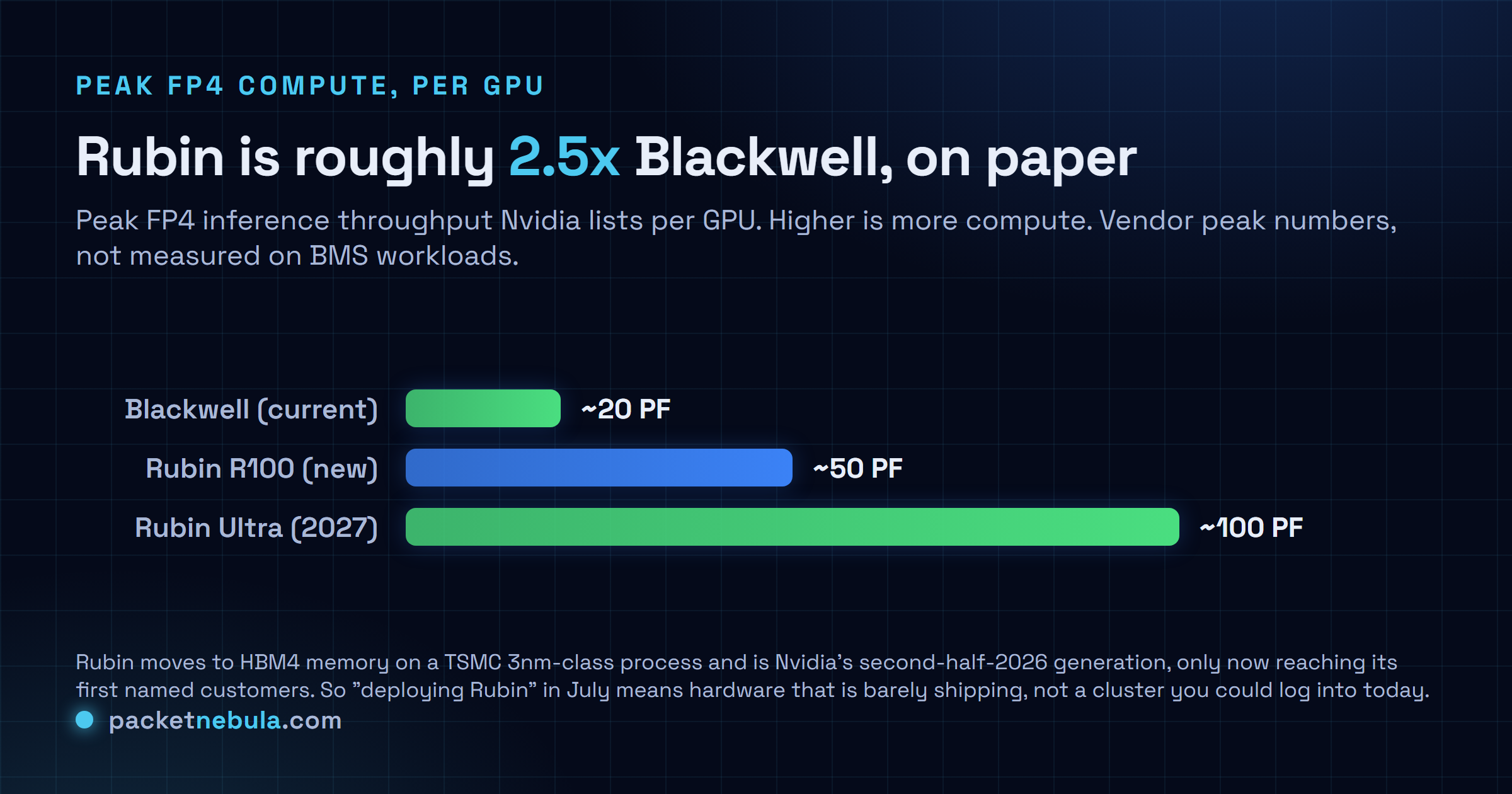
Rubin is the architecture after Blackwell, Nvidia’s second-half-of-2026 generation, pairing a Rubin GPU with a Vera CPU (hence “Vera Rubin”). Nvidia lists the Rubin GPU around 50 petaflops of FP4 compute, against roughly 20 on a Blackwell GPU. Call it 2.5x on paper. It moves to HBM4 memory on a TSMC 3nm-class process, and an NVL72 rack packs 72 of those GPUs together. A beefier Rubin Ultra, at about double again, is penciled in for 2027.
The catch is timing. Rubin is barely out the door. Nvidia’s own roadmap puts broad availability across the back half of 2026, ramping into next year. So “deploying Vera Rubin” in July doesn’t describe a room full of humming racks. It describes an order for silicon that’s just starting to land. Same shape as the rest of Nvidia’s 2026 lineup, honestly, where the Jetson Thor mainstream modules were announced with a Q1 2027 ship date. Announcement and availability are two different calendars.
The 10x, read honestly
This is the number that’ll get screenshotted, so let’s be precise about it.
The claim is “up to 10x the performance per megawatt of the infrastructure it replaces.” Three quiet qualifiers do a lot of work there. It’s per megawatt, which is efficiency, not throughput. It’s “up to”, which is the best case. And “the infrastructure it replaces” means BMS’s own three-year-old DGX SuperPOD, roughly two GPU generations back, not a current Blackwell box.
Put those together and the claim is entirely plausible. Two generations of Nvidia silicon plus denser racks really can deliver a large efficiency jump per watt. It’s just not the same sentence as “your training runs finish 10x faster.” I might be wrong about how BMS reads it internally, but for anyone repeating the figure, per-megawatt is the word that matters.
And per megawatt is the right frame, because power is the actual ceiling now, not chips. That’s the whole story behind moves like New York pausing 50MW-plus data centers. When a state starts gatekeeping by megawatt, performance per megawatt stops being a marketing slide and starts being the thing that decides whether your cluster gets built at all.
Why it matters, and what to ignore

Strip out the pharma glow and there are two useful signals for the rest of us.
First, Rubin has named enterprise customers outside the hyperscalers now. That’s a real data point about the Blackwell-to-Rubin handoff being on track, the kind of tea-leaf worth more than any single benchmark. Second, the pitch is built entirely around watts. Everyone is converging on the same constraint, which is also why labs like Meta keep spinning up their own inference silicon instead of only buying Nvidia.
What to ignore: the drug-discovery payoff, at least for now. New medicines take years to move through the clinic, so no July 2026 press release can point at one and say the AI factory did that. It might, eventually. Today it’s a compute purchase with a good story wrapped around it. Buy the hardware read. Hold the miracle-cure read.
Sources: NVIDIA Blog, Bristol Myers Squibb press release, HPCwire and Nvidia Rubin architecture overview, July 2026. The July 20 deployment, the eight DGX Vera Rubin NVL72 systems, the “most powerful and energy-efficient AI cluster in life sciences” phrasing and the up-to-10x performance-per-megawatt claim are attributed to NVIDIA and BMS. The Rubin and Blackwell FP4 figures, HBM4, process node and the second-half-2026 timeline are as published on Nvidia’s architecture roadmap. Per-GPU peak numbers are vendor specs, not measured on BMS workloads.
Frequently asked questions
Is NVIDIA Vera Rubin shipping yet?
Barely. Rubin is Nvidia's generation after Blackwell, slated for the second half of 2026, and it is only now reaching its first named customers. When Bristol Myers Squibb said on July 20 it will deploy DGX Vera Rubin NVL72 systems, that is a purchase commitment for hardware that is just starting to ship, not a cluster running workloads today.
What did Bristol Myers Squibb actually announce?
On July 20, 2026, BMS said it will add a second NVIDIA DGX SuperPOD, built on eight DGX Vera Rubin NVL72 systems, to the DGX SuperPOD it first deployed about three years ago. Nvidia billed the combined setup as the most powerful and energy-efficient AI cluster in life sciences. The workloads named are proprietary foundation models and agentic drug-discovery workflows, run on the NVIDIA BioNeMo Agent Toolkit.
What does the 10x performance per megawatt claim mean?
It is Nvidia's figure, and it is an efficiency number rather than a raw speedup. The claim is up to 10x the performance per megawatt of the infrastructure it replaces. Two things to hold onto: it is per megawatt of power, and it is measured against the gear BMS ran roughly three years ago, not against current Blackwell systems. So it is believable, and also not a promise that your jobs finish 10x faster.
How is Vera Rubin different from Blackwell?
Rubin is the next architecture after Blackwell. Nvidia lists the Rubin GPU at roughly 50 petaflops of FP4 compute, against about 20 on Blackwell, so around 2.5x on paper per GPU. It moves to HBM4 memory on a TSMC 3nm-class process. A follow-up, Rubin Ultra, is a 2027 part at roughly double again. These are vendor peak numbers, not results measured on BMS drug-discovery work.
Should this change how I buy AI hardware?
Probably not this week. The useful signal is quieter than the headline. Rubin now has named enterprise customers beyond the cloud giants, and the whole pitch is framed around performance per megawatt because power, not chips, is the ceiling in most data centers now. If you are sizing a cluster, that per-megawatt framing is the number worth copying, not the drug-discovery story.